Coercion
By Somaia Ramish
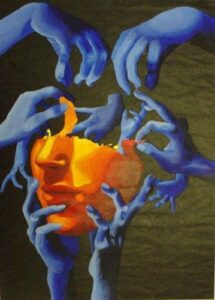
I can break coercion into three pieces,
swallow it down three times a day,
but I cannot weave it into poetry for you.
Yes,
coercion is a bitter meal,
served morning, noon, and night
to girls who closed their eyes at dusk
and never saw another dawn.
Night clung to life,
to dreams,
to the scent of bread that never rose.
Coercion is not poetry.
I cannot fold it into a page,
crumple it,
cast it away.
It looms larger than me,
larger than
Band-e Amir
Goharshad’s gardens
the vineyards drunk on forgotten sun.
Coercion is a nightmare,
stitched to the unfinished dreams of our daughters.
It does not divide,
it multiplies,
seeps into all things.
It is vaster than a homeland
and has devoured time itself.
No one speaks its name.
Even the BBC would rather whisper
of Johnny Depp’s broken—or unbroken—finger
than murmur the ruin of a girl’s forsaken dream.
But this is not news.
It is coercion,
spreading like plague,
dragging us back to a century
where no one even lifts a brow
for the Universal Declaration of Human Rights.
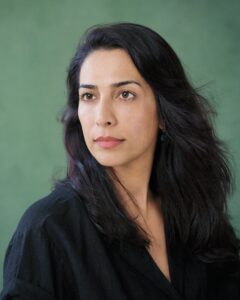
Somaia Ramish is a poet, writer, and human rights activist whose influential voice resonates in the world of literature and human rights advocacy. She holds a Master’s degree in Persian Language and Literature from the University of Delhi, India, and is currently a Ph.D. candidate in the same field.
She currently leads “Baamdaad: House of Poetry in Exile,” a global movement she founded to protest against censorship and the repression of literary and artistic expression in Afghanistan and beyond. This initiative has become a beacon of hope, uniting artists and poets worldwide in solidarity with Afghan creatives facing severe restrictions under the Taliban regime.
Her poems have been translated in multiple languages and her poetry collections have been published in the Netherlands, France, Italy, and Japan.
Ramish has been honored with prestigious awards and medals for her contributions to literature and human rights in addition to her writing, Somaia Ramish regularly lectures at various universities on poetry and literature, with a special focus on women’s poetry in Afghanistan and she regularly participates in international conferences and festivals, serving as a powerful voice for Afghan women and artists who are forced into silence.
Her poetic talent, combined with an unwavering commitment to human rights and freedom of expression, continues to inspire many, establishing her as a vital figure in both the literary and activist communities.