Leaving
By Nahid Salimi & Beheshta Adel
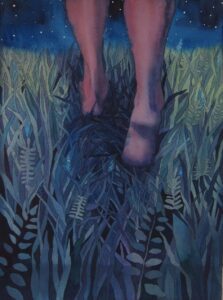
These are the feet of a girl from Afghanistan, feet that have never chased a ball across a field, never kicked one into a goal, never ran wild outside just for fun. They are not worn out from sports or play, but from quiet waiting, from standing still when they want to move, from walking carefully through a world that doesn’t always feel safe.
Do I love sports? Yes, though my feet have never felt the thrill of sprinting after a ball, my heart has always longed for it. My feet have never known the joy of a game, not because they couldn’t, but because they were told they shouldn’t. In my culture, if my feet had ever touched a ball, it would be called shameful.
Yet, these feet are strong. They have carried the weight of silence and of dreams unspoken. They have walked paths many will never understand. And even if they’ve never touched a ball, they still carry me forward, towards a future where maybe, just maybe, no girl will be told what her feet cannot do.
I am not a footballer, and I will never be one. But now, I live outside Afghanistan, and the future I am walking toward seems clearer. I will work to change the world for girls. I want the next generation of Afghan girls and girls everywhere to never be told they cannot play just because of their gender.
Despite the fear and uncertainty of leaving my homeland, I have the courage to start over. Now, these feet carry me forward on a path of change, towards a world where every girl can run freely, chase her dreams, and decide for herself what her feet can do.
Nahid was born in Afghanistan. Her life was flipped upside down when the Afghan government fell. She was in 9th grade at the time. The future she was hoping for changed, and deemed all her aspirations impossible.
Nahid found an opportunity to continue her education with Brave Future in 2023. Currently, she resides in Portugal, pursuing her education in Computer Science. Although she admires the field of technology and the devices, and the opportunities it brings, her deepest passion is politics and political science.
Her vision is to be a lawmaker not for the title, but to genuinely make a difference. She is driven by a vision of helping to create a world free of barriers for girls, a world where no one is discriminated against based on their gender, culture, or place of birth. She is motivated by her past, being prepared by her education, and steered into the future she desires by her passion.
Beheshta Adel
Thin, long legs stand upon her two regular-sized feet, as gentle and grounded as the slender trunk of a young tree resting in its roots. Not swift or fierce enough to win a marathon—yet not frail enough to surrender halfway through. They carry her, steadily, faithfully. Always somewhere between strength and softness.
From the earliest days of childhood, these feet have refused stillness. Ever in motion—barefoot sprints under warm summer rains, quiet strolls through Kabul’s dusty alleys, spontaneous twirls to distant music, playful rides on her brother’s rusted bicycle, or simple, quiet shifts while waiting in a line at the bakery.
Her mother says they never stopped kicking, even in the womb—as if impatient to enter the world, eager to move, to dance, to run.
They’re most comfortable unclothed, or wrapped in loose, flowing trousers that kiss the ankles and let them breathe. Tightness—whether in fabric or feeling—has never suited them.
These feet, with the quiet strength of her legs, have carried her through more than just places. They’ve fled border guards under moonless skies, stood for hours behind shop counters, walked unfamiliar roads toward unfamiliar futures.
But even in hardship, they never missed the poetry of small joys—pressing bare soles into dew-soaked grass, leaping without thought onto a sun-warmed bed, tiptoeing across cool tiles on a summer night.
They are not just limbs—they are memory keepers. They hold the weight of her journey, the rhythm of her laughter, the traces of places she’s called home.
Beheshta Adel, 19, was born and raised in Kabul, Afghanistan, where she spent most of her childhood and adolescence. At 16, when the Taliban took over the country, she migrated with her family to Iran. Her passion for writing, particularly poetry, began during that time, when literature became her only shelter in an unfamiliar world. This passion deepened after an Iranian friend introduced her to the works of Sohrab Sepehri, whose poems free of rhyme and written like prose were unlike anything she had encountered before. Inspired, she began writing her own poems, mostly in Farsi but also in English.
Currently based in Islamabad, Pakistan, she is preparing to move to Indonesia to pursue a bachelor’s degree in IT. While university life will demand much of her time and effort, she remains certain that poetry and literature will continue to be a refuge in both her good and difficult days.