Dignity in the Pit of Humiliation
By Marwa Karimi
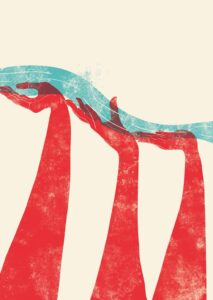
I held my head in my hands. Not from physical pain, but from the bitterness of that moment when humanity was trampled underfoot. They were pouring cold water over me, like the hateful stares fixed upon me. My clothes were black, not by chance, but perhaps a reflection of my fate and destiny, which from the beginning until this very moment, had been feeding me a slow, silent death. I said nothing. My mouth was closed, but inside me, like a dormant volcano, there was an uproar. I was breaking, but I made no sound.
I had committed no crime, only that I was Afghan. Just that. In a world where being human means nothing if your passport is from a scorched land, I wasn’t even allowed to feel pain, let alone defend myself. They poured water and laughed. Teenagers perhaps too young to even understand the shame of what they were doing.. Their phone cameras captured the breaking of a man who was once a teacher, with joy. A man who once held a pen and filled blackboards with love was reduced to nothing.
My heart ached. Not from the cold, not from the insult, but from something heavier. It broke from the fact that I couldn’t even bring warm bread home to my family. That stale bread I found was all we could share, and still, I endured. I let go of my pride. Pride that was born in the soil of Herat, among students who once called me “Ustād.” And now, in the back alleys of a foreign land, I’m called a filthy Afghan.
Migration is not a journey, it’s a fall. It strips a man of his status, his roots, his voice, and his dignity, and throws him into a place where he is seen not as human, but as the “other.” In the country we fled to, simply to survive, we are seen as a stain. When you’re Afghan, they don’t ask your name, your past, or your character. All you hear is, “Get out!” And if you don’t, you’d better be ready for kicks, insults, and the cold eye of a phone camera.
Why? Why must a migrant be so voiceless that even his pain becomes entertainment for others? Why does an Afghan’s tears bring laughter? Why does no one ask themselves – This soaking wet man, did he once light homes with knowledge? Why is it so hard to believe that I was a teacher, that my father was a farmer, that my mother once prayed I would become
“Ustad, not filth”?
When I returned home, my daughter asked, “Why are your clothes wet, why are your eyes red?” I didn’t answer. How could I tell her that her father was soaked in water and dried in humiliation, just because he was Afghan? How could I explain that the dry bread on the table tonight cost me the last bit of my dignity? This wound is not just mine. It belongs to a generation that escaped death only to fall into pain. They called us liars, thieves, and lazy. But no one mentioned that we fled war, from a land more familiar with bombs than with rain. No one cared that in that land, I was a teacher. No one asked how many students, how many bright eyes, how many hopes I nurtured. Humiliation, when recorded on camera, becomes more than just pain, it becomes torture. A video shared on social media is not only laughter from them, but silence from you. Who lost sleep over my tears? No one. Because I am Afghan.
If I ever return to my country, nothing will be the same. Not its soil, not its houses, not my heart. Because I will return with a wound that has no voice, with a pride that’s buried, with a memory that carries pieces of humiliation with every breath. People think migration means comfort. They don’t know that migration is a slow death – quiet, and without a grave. Some nights, when my daughter is asleep, I sit and think of that blackboard where I once wrote in white chalk, Humanity has no borders. That sentence now feels like a joke in my mind. Because for me, there were far too many borders. The border between human and Afghan, between teacher and filth, and between pain and shame. I wish I could shout. I wish this sentence could be written, not on walls, but on human hearts: We were only born elsewhere. Our crime is not that we are Afghan. The true crime is that humanity has died.
Marwa Karimi is a writer from Herat, Afghanistan. She is the author of the book “Yaqoot e Surkh” and writes emotionally driven narratives, often centered around themes of displacement, identity, and dignity. Dignity in the Pit of Humiliation reflects the lived experiences of Afghan migrants. Though brief, it comes from the heart.